
If you’ve fallen behind on mortgage payments, foreclosure is not automatic and it’s not instant. Most Tennessee lenders won’t file anything until you’re 120 days past due, which means there’s usually a real window to fix the problem, negotiate with your lender, or sell the house before it ever reaches a courthouse steps sale.
That gap between “I missed a payment” and “the bank is foreclosing” is where most of the stress lives, mostly because nobody explains what actually happens during it. This guide walks through that window plainly: what your lender can and can’t do right away, which options are realistic depending on how far behind you are, and when selling the house outright — including to a company that will pay cash for houses as-is — starts to make more sense than trying to hang on.
What Actually Happens After You Miss a Payment
One missed mortgage payment rarely triggers anything dramatic. Most loan servicers consider a payment late after the grace period (usually 15 days), and a single missed payment typically results in a late fee and a phone call, not legal action. The real shift happens around 90 days, when many servicers formally classify the loan as being in default. Even then, in Tennessee, lenders generally can’t file a Notice of Default and begin the formal foreclosure process until a payment is 120 days past due, under federal servicing rules.
So if you’ve missed one or two mortgage payments, you’re almost certainly not facing foreclosure yet. You’re in a window where your choices are still wide open, and the earlier you act inside that window, the more options stay on the table.
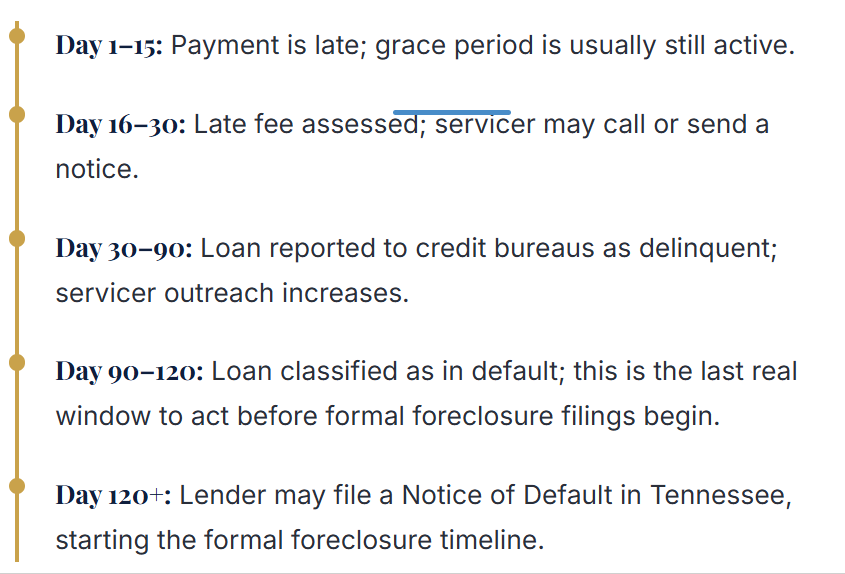
Day 1–15: Payment is late; grace period is usually still active.
Day 16–30: Late fee assessed; servicer may call or send a notice.
Day 30–90: Loan reported to credit bureaus as delinquent; servicer outreach increases.
Day 90–120: Loan classified as in default; this is the last real window to act before formal foreclosure filings begin.
Day 120+: Lender may file a Notice of Default in Tennessee, starting the formal foreclosure timeline.
Exact numbers vary by lender and loan type (FHA and VA loans often have longer timelines and more assistance options than conventional loans), so it’s worth calling your servicer directly and asking exactly where your loan stands. That call is uncomfortable, but it’s also the fastest way to know how much time you actually have.
Your Options While You Still Have Time
Once you know where you stand, the choice usually comes down to one of a few paths. None of them is universally “best” — it depends on how far behind you are, whether the shortfall is temporary or ongoing, and how much equity is in the house.
Option 1
Catch Up or Get a Repayment Plan
If the missed payments came from a short-term setback — a layoff you’ve since recovered from, a medical bill, a temporary cash crunch — your servicer may agree to a repayment plan that spreads the missed amount across future payments, or a forbearance that pauses payments temporarily.
Option 2
Loan Modification
If the shortfall is ongoing rather than temporary, a loan modification changes the terms of the mortgage itself — a lower rate, a longer term, or added principal at the back end — to bring the monthly payment down to something sustainable.
Option 3
Sell Before It Becomes Foreclosure
If the payments simply aren’t going to be sustainable no matter what’s restructured, selling the house — either on the open market or to a buyer who will pay cash for houses as-is — lets you settle the loan on your terms, protect your credit from a foreclosure filing, and walk away with whatever equity is left.
Why Selling Sometimes Beats Waiting It Out
Catching up and modifying the loan work well when the underlying problem is temporary. But if you’re already stretched thin on mortgage payments and don’t see that changing, waiting can quietly cost more than it saves. Late fees stack up, the loan balance grows, your credit takes a harder hit the longer it drags on, and if it does reach a foreclosure filing, you typically walk away with far less than you would from a straightforward sale — sometimes nothing at all.
Selling as-is avoids most of that. There’s no need to make repairs, stage the house, or wait through a traditional 60–90 day listing process while payments keep piling up. A cash sale can close in about a week, which matters most when the calendar itself is working against you.
What a Cash Sale Actually Looks Like
Selling to a company that will pay cash for houses in any condition removes most of the moving parts that slow a traditional sale down. There’s no bank underwriting on the buyer’s end, no financing contingency that can fall through at the last minute, and no requirement to fix anything before closing. You get an offer, you review it with no obligation to accept, and if it works for your situation, closing can happen in days rather than months — often fast enough to pay off the loan before a foreclosure filing is even possible.
Behind on Mortgage Payments in Memphis?
Talk to a local buyer before your lender’s timeline forces a decision for you. We’ll give you a straightforward, no-obligation cash offer and walk you through exactly how a sale would pay off what’s owed.
Frequently Asked Questions
How many missed mortgage payments before foreclosure starts in Tennessee?
Under federal servicing rules, most lenders can’t file a Notice of Default until a loan is at least 120 days past due — generally around four missed payments. Some lenders move faster once that threshold is hit, so it’s worth confirming your loan’s specific status directly with your servicer.
Will missing a mortgage payment hurt my credit right away?
Usually not immediately. Most servicers don’t report a late payment to credit bureaus until it’s 30 days past due. A single late payment inside the grace period typically doesn’t show up on a credit report at all.
Can I sell my house if I’m behind on mortgage payments?
Yes. As long as the sale price covers what’s owed on the loan, you can sell at any point before a foreclosure sale is finalized. If there’s equity left after paying off the loan, that difference is yours at closing.
What if I owe more than the house is worth?
This is called being underwater, and it limits your options but doesn’t eliminate them. A short sale, where the lender agrees to accept less than the full loan balance, may be possible — that requires lender approval and typically takes longer than a standard sale.
Do I have to fix up my house before selling it for cash?
No. Buyers who pay cash for houses typically purchase properties in their current condition, repairs, code issues, and all, which is part of why the process moves faster than a traditional listing.